What is a Certificate Authority (CA)?
The Bedrock of Digital Identity
Understanding the cryptographic core of Public Key Infrastructure, trust hierarchies, and machine identity governance.
PKI Fundamentals
6 min read
28 May 2026
In an era defined by decentralized cloud operations, global edge networks, and complex software-defined environments, establishing absolute trust is a foundational requirement of enterprise security. At the center of this trust architecture sits a critical piece of cryptographic infrastructure: the Certificate Authority (CA).
A Certificate Authority is a trusted third-party entity—either public or private—responsible for issuing, managing, validating, and revoking digital certificates. By binding a public cryptographic key to a verified identity, a CA enables encryption and authentication across the web.
How a Certificate Authority Establishes Trust
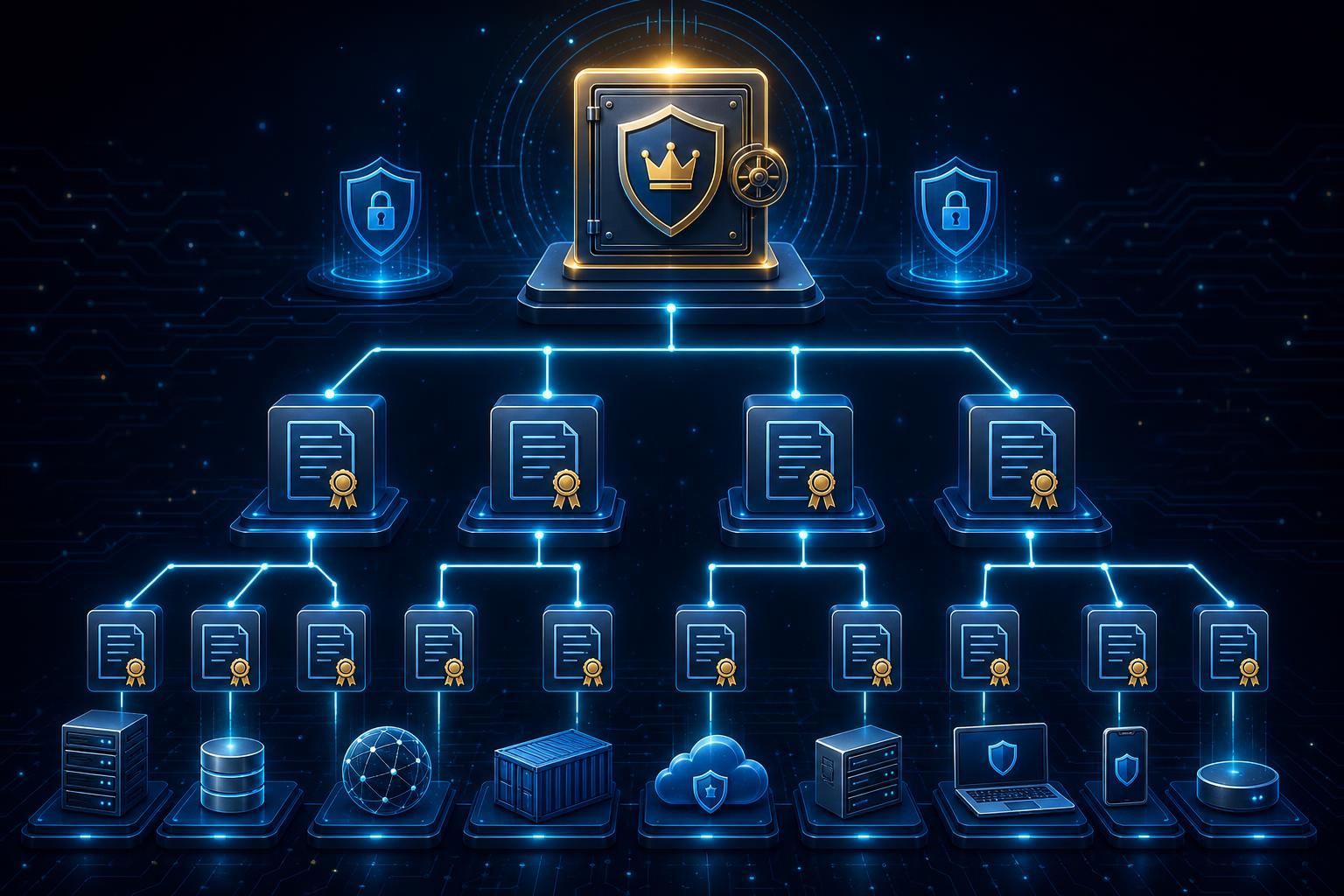
A CA does not operate in isolation. It functions as the apex of a hierarchical system known as the chain of trust. Every certificate issued in a properly architected PKI can be traced upward to a trusted root, creating an unbroken cryptographic lineage that operating systems, browsers, and enterprise devices validate automatically.
Root CAs: The Ultimate Anchor
The absolute top of the trust hierarchy possessing a self-signed certificate. Root CAs are implicitly trusted by operating systems and kept strictly offline in secure vaults to prevent catastrophic compromise.
Intermediate CAs: The Operational Layer
Delegated signing authorities created by the Root CA. They handle day-to-day issuance and validation of certificates, insulating the core Root CA from direct operational exposure.
End-Entity Certificates: The Leaf Nodes
The operational certificates deployed directly onto endpoints—protecting public web servers, authenticating containerized workloads, and securing localized edge devices.
Public vs. Private CAs: Choosing the Right Architecture
Not every enterprise scenario calls for the same type of Certificate Authority. Understanding the distinction between public and private CAs is essential for aligning cryptographic governance with your organization's risk posture and operational scope.
Public Certificate Authorities
Bound by strict CA/Browser Forum rules and globally trusted by default across all browsers and devices. Essential for external, internet-facing assets, user applications, and public API endpoints.
Private Certificate Authorities
Controlled internally within an enterprise's network boundaries. Tailored for internal machine-to-machine authentication (mTLS), container environments, microservices, and secure infrastructure isolation.
The Modern CA Challenge: Velocity and Automation
The operational reality of certificate management has fundamentally shifted. What was once a quarterly or annual procurement exercise—submitting a Certificate Signing Request (CSR), validating domain ownership, and installing the resulting certificate manually—has evolved into a continuous, programmatic discipline.
With the impending 47-day certificate lifespan mandate, manual processes are no longer merely inefficient: they are operationally impossible. Enterprises must integrate Certificate Authorities directly into automated deployment environments using protocols like ACME (Automated Certificate Management Environment) to ensure certificates are discovered, renewed, and deployed without human intervention.
Failure to automate at this velocity introduces catastrophic risks: expired certificates triggering customer-facing outages, configuration drift leaving endpoints unprotected, and compliance gaps during audit cycles. The CA is no longer an external vendor relationship—it is a core dependency of your infrastructure's heartbeat.
Establish Resilient Machine Identity Governance
Move beyond manual certificate tracking. Architect a secure, automated, and self-healing PKI framework that protects your enterprise across every domain.