Enterprise Security Strategy
Why manual PKI management is no longer viable and how to architect for continuous automated lifecycle operations.
Enterprise Security Strategy
5 min read
28 May 2026
The cryptographic runway has officially run out. What began as a series of industry proposals has crystallized into a definitive mandate: the maximum lifespan of public TLS/SSL certificates is officially reducing to 47 days.
This transition represents the most aggressive contraction of digital trust windows in the history of the web. For global enterprises managing complex network architectures, cloud-native application footprints, and distributed endpoints, this shift changes certificate lifecycle management (CLM) from a routine security practice into a mission-critical operational requirement.
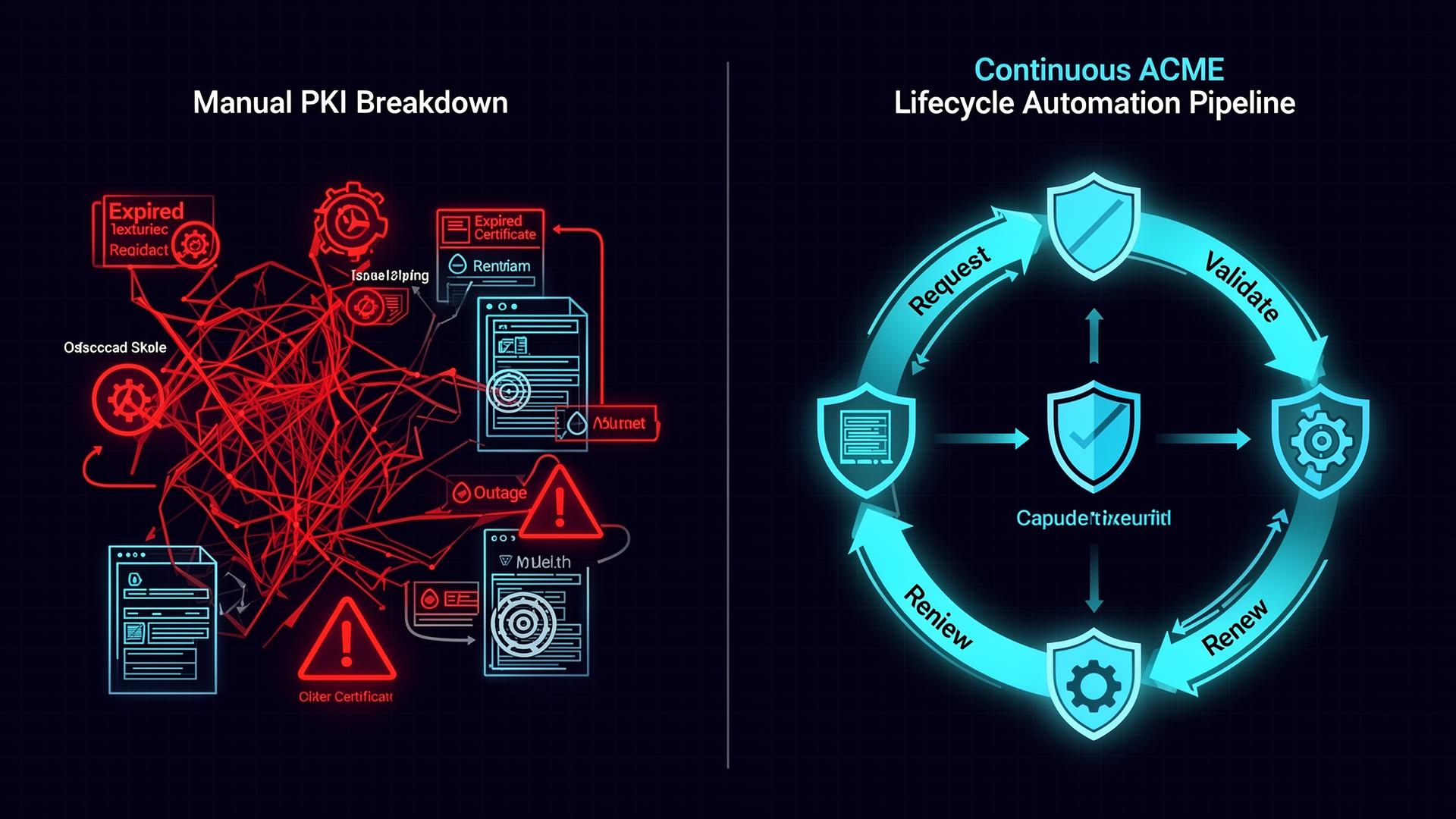
Manual PKI Breakdown vs. Continuous ACME Lifecycle Automation Pipeline
Why the Industry Standardized on 47 Days
Eliminating the Revocation Gap
Shorter validity ensures compromised keys expire quickly, replacing unreliable CRL and OCSP mechanisms.
Enforcing Global Cryptographic Agility
Preparing the enterprise ecosystem for a rapid, seamless shift to Post-Quantum Cryptography (PQC).
Operationalizing Zero-Trust Machine Identity
Treating digital certificates as dynamic credentials requiring programmatic, machine-to-machine validation.
The Operational Ripple Effect Across the Enterprise
Cloud and Container Environments
Managing sprawling container environments or consolidating fragmented architectures becomes highly volatile under a 47-day rule. Without standardized runtime or OS baselines, high-frequency rotations increase the risk of broken API gateways and cascading downtime.
Edge Infrastructure and Connected Assets
High-stakes edge ecosystems—such as Software-Defined Vehicles (SDVs) or charging networks leveraging TLS 1.3 and ISO 15118-20 standards—cannot tolerate friction. Manual intervention or uncoordinated scripts introduce severe compliance drift.
Data Center Migrations
Executing data center modernizations across bare-metal servers or legacy virtualization layers introduces a rapidly moving target. Tracking active certificates mid-migration without automation spikes the likelihood of a critical live workload going offline.
Transitioning to Platform Lifecycle Governance
Natively Automated Protocols (ACME)
Programmatic request, challenge, and deployment natively integrated into operating systems and load balancers.
Unified Control Planes
A centralized source of truth monitoring expiration, cipher suites, and root chains across public clouds and local data centers.
Policy-as-Code Compliance
Injecting security constraints directly into automated pipelines to prevent configuration drift during high-frequency renewals.
Accelerate Your Cryptographic Agility
Do not wait for certificate expiration outages to force your hand. Design an automated, resilient, and self-healing trust infrastructure today.